


ZIGONG LANDSCAPEDINO TECHNOLOGY CO., LTD. is a professional designer and supplier of animatronic dinosaurs, dinosaur costumes, dinosaur rides, dinosaur fossils/skeletons, animatronic animals and insect models. Our company is located in Zigong City, Sichuan Province, Southwest China, the hometown of dinosaurs, and consists of a team of designers and engineers with over 10 years of experience. We aim to help customers around the world create and open dinosaur/Jurassic theme parks, zoos, museums, exhibitions and events, and have produced a series of products that have been exported to more than 60 countries.
High Productivity
We have our own large-scale factory covering an area of 13,000 square meters, with an annual output of more than 300 electronic dinosaurs. We can guarantee delivery time and provide delivery inspection before shipment.
Quality Assurance
Our production process complies with ISO testing, and each model obtains SGS certification and CE certificate. We conduct appearance and aging tests on the finished product after completion, and provide on-site installation and two-year warranty service.
Multiple Shipping Options
We accept EXW, FOB, CNF, CIF, DDU, DDP as well as air, sea, train transportation and international express for all orders, you can contact our team.
Customized Services
Our products support customized designs of any size, color, posture, movement, material, sound and variety, as well as OEM, ODM orders.


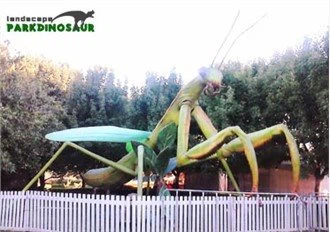

What is Animatronic Insect?
Animatronic insects are giant robotic models of bugs that are often used for educational purposes, include Dragonflies, Mantises, Spiders, Snails. They can be made from a combination of steel, fiberglass, and silicone skin material, the silicone skin material can protect the insects from the sun, rain, and snow. Animatronic insects can They are usually much larger than real insects, allowing audiences to see more details. They are often used in schools, museums, and insect theme parks, science museums, and as gimmicks and attractions for businesses.
Features of Animatronic Insect
Rich Variety
Our animated insects are produced based on their true proportions and characteristics and come in a variety of species and sizes, including scorpions, wasps, spiders, butterflies, snails, centipedes, lucani, beetles, ants, and more.
Flexible Control
These electronic insects can be controlled through flexible methods, including infrared sensing, remote control, buttons, touch sensing, automatic, etc., allowing them to display mouth opening and closing, sound, eye blinking, tail wagging and other actions.
Freely Placed
They can be placed in any corner of parks, squares and other places, or hung in the air, fixed on walls, or placed in water. Their fully sealed design allows them to work underwater.
Wide Uses
These products are suitable for attraction and promotion activities in zoos, insect parks, theme parks, exhibitions, and city squares, and can also provide insect enthusiasts and students with the opportunity to study insect structures up close.

●Park Decoration:In recent years, a new decorating trend has developed as garden centers look for new, eye-catching ways to stand out from the competition. The lifelike shapes and sizes of giant insects have allowed them to find a home in garden centers around the world. Made from high-density sponge and silicone rubber, these insects feature detailed skin texture and realistic colors. We use this unusual decoration technique to attract customers. Many huge insects can be seen here, including bees, butterflies, dragonflies, grasshoppers, ladybugs, etc. These giant insects have become a popular new addition to garden centers as they not only spark curiosity in children, but also spark conversation and interest in adults.
●Educational Activities:These insects enhance their beauty as decorative items in garden centers, but they also serve as a novel marketing strategy to attract large numbers of customers, especially those with a strong interest in insects. However, these insect decorations also give it a fresh educational dimension. Children can learn a lot from these animals, helping them connect with nature and stimulating their interest in natural sciences.
●Popular Science about Insects:The grand outdoor electronic insect exhibition allows visitors to observe the structure, movement and living habits of insects up close. The "big" insect models are based on reality and scaled up by professional designers. The completely hand-made production process brings the insect models to life with meticulous attention to detail. Tiny movements such as blinking, head movement, antenna movement and wing flapping bring these insect models to life. At the same time, they are accompanied by the sound of insects, creating an immersive experience.
Body Structure of Animatronic Insect
Three-part Body
Insects have a segmented body supported by an exoskeleton, the hard outer covering made mostly of chitin. The body is organized into three interconnected units: the head, thorax and abdomen. The head supports a pair of sensory antennae, a pair of compound eyes, zero to three simple eyes (or ocelli) and three sets of variously modified appendages that form the mouthparts. The thorax carries the three pairs of legs and up to two pairs of wings. The abdomen contains most of the digestive, respiratory, excretory and reproductive structures.
Segmentation
The head is enclosed in a hard, heavily sclerotized, unsegmented head capsule, which contains most of the sensing organs, including the antennae, compound eyes, ocelli, and mouthparts. The thorax is composed of three sections named (from front to back) the prothorax, mesothorax and metathorax. The prothorax carries the first pair of legs. The mesothorax carries the second pair of legs and the front wings. The metathorax carries the third pair of legs and the hind wings. The abdomen is the largest part of the insect, typically with 11–12 segments, and is less strongly sclerotized than the head or thorax. Each segment of the abdomen has sclerotized upper and lower plates (the tergum and sternum), connected to adjacent sclerotized parts by membranes. Each segment carries a pair of spiracles.
Exoskeleton
The outer skeleton, the cuticle, is made up of two layers: the epicuticle, a thin and waxy water-resistant outer layer without chitin, and a lower layer, the thick chitinous procuticle. The procuticle has two layers: an outer exocuticle and an inner endocuticle. The tough and flexible endocuticle is built from numerous layers of fibrous chitin and proteins, criss-crossing each other in a sandwich pattern, while the exocuticle is rigid and sclerotized. As an adaptation to life on land, insects have an enzyme that uses atmospheric oxygen to harden their cuticle, unlike crustaceans which use heavy calcium compounds for the same purpose. This makes the insect exoskeleton a lightweight material.
Build a Realistic Insect Structure from Wire
Choosing an Insect and Planning
To build a wire insect (or really any sort of bug), you need to start with a plan. This process is much easier than you might think, and all you really need are a few sketches of the insect you are trying to make and from there you can develop a plan of attack.
Most insects have many body segments, so start by determining what those should look like for the bug you choose. I decided to make a locust for this project, and from looking at some sketches I could see that I wanted to make him using 3 body segments, one for the head, one for the midsection, and one for the long rear section underneath the wings.
After you have an idea of what the main body should look like, you can think a bit more about the other components of your insect. Some of these sections like wings will have to be made separately and attached, while smaller bits like sets of legs can be made shaped directly onto the body sections.
A very important consideration with wire sculpture is that ends of wires look MESSY and can be VERY DIFFICULT to hide or make look good. Thus, with the main structural sections of your insect should be made with a SINGLE CONTIGUOUS piece of wire. You might not think this is important, but doing this will vastly improve the appearance and structural stability of your sculpture.
Additionally, always consider symmetry. Most insects are very symmetric so be sure to look your insect head-on every once in a while.
Gather the Necessary Materials and Tools
To form your wire into a bug, you will want to get a few different gauges of wire. You can certainly use coated wire (like that used in electrical applications), but single strand wire found at a hardware store or an art store is the best.
As you will quickly find out, you will want a set of cutters to cut your wire. Both end cutters and diagonal cutters (pictured respectively) work fine for this, as long as you can get good at cutting very close for those wire ends.
I advise you practice a little bit with a short section of your thick wire before you start, because you want to be able to do consistently very tight wraps at every structural joint, and doing this requires a bit of practice and skill. I advise using needlenose round or bent pliers for most work, but bigger/thicker standard pliers may still be useful for fixing or improving your wraps, as well as doing tight bends of any sort.
Starting With the Body
With the body, aim to build the entire thing in one piece. Begin by bending the wires into the rough shapes you are aiming for before you cut the wire and USE A RULER to help get the dimensions right such that your bug doesn't look wonky. Then, you can cut your wire and begin making your first wraps, but only do as many wraps as necessary for a tight joint- usually 2-3- because more may make your sculpture look cluttered and ugly, and if you need that many, your wraps are likely not tight enough anyway. ALSO VERY IMPORTANT- when making wraps, squeeze them together so that they are neater, though be sure to do this throughout the process because this can also make each wrap a little looser.
Building and Adding Legs, Antennae and (if Necessary) Wings
Go into each additional component with a bit of extra wire, ensuring everything is symmetric, and wrap away to your heart's content. With bigger pieces like wings, you may want to build them separately entirely from the body, adjust them such that they look right, and attach them with many wraps of a thinner gauge wire. You may also put consideration into how you want to fill your empty spaces rather than have single stranded wire.
Finishing Touches and Tips
Finally, assess what you feel is missing from your insect or bug and add it! I felt that my locust needed a set of eyes, so I made them from some thin gauge wire and attached them. If you're insect still looks a little empty, you may want to add some thinner gauge wire to improve that, and you may find that some of your wraps are a bit messy, and you can certainly put the work into making them look nice and neat.
Maintenance of Animatronic Insect
Today I will tell you about the daily maintenance and maintenance of insects. insects are most afraid of the sun in summer. Therefore, the best choice for insect exhibitions is spring and autumn. The north is too cold in winter, and insects are prone to failure. Regular maintenance can increase the life of insect models. It can also make insects more stable in use. Basic maintenance has the following three points: 1. Maintenance of the insect skin, 2. Maintenance of the insect internal transmission, and 3. Maintenance of the insect control box.
Whether a insect is new or old is our first impression. Of course, it depends on whether the skin is new or old. The insect skin of some companies is very worn and cannot be exhibited after being pulled to the event site. Barely exhibiting will also reduce the level of the organizer. How should we maintain the insect skin in ordinary times? As mentioned earlier, we must avoid prolonged exposure to ultraviolet light. Long-term exposure to sunlight on insects will cause the insect’s skin to peel, peel, and dregs. We must also avoid the cold weather in the north. The temperature is too low. If it ’s not like the insects we produce will appear in cities with normal temperatures, the insect ’s skin will open up. Friends who have seen insects know that the insect ’s skin is made of silicone. It is easy to damage it with a knife.
It is not professional for the interior of the insect to find out where the transmission part is. Therefore, we must find a professional company like us to maintain it. In the summer, the insect must be opened and lubricated on the transmission place. Oil, antifreeze should be placed on the transmission place in winter. Only in this way can the smoothness and resistance of the transmission part of the insect be guaranteed.
The insect control box is also called the insect electric box. It is the control of what a insect is called, how long it is called, when it moves, and how long it moves the brain. The electronic motherboard inside it, the sound control system must be kept dry and regularly cleaned with gasoline. Special attention should be paid to cleaning the connection in the electric box.
Certificate Photo


Factory Photo


Frequently Asked Questions of Animatronic Insect
We're professional animatronic insect manufacturers and suppliers in China, specialized in providing high quality customized products. We warmly welcome you to buy or wholesale high-grade animatronic insect for sale here from our factory. For price consultation, contact us.
Life Size Dinosaur, Jurassic Creatures Animatronic Life Size Statue, Realistic Animatronic Giant Insect Statue for Zoo